
🇬🇧 🇪🇸
Israel Centeno
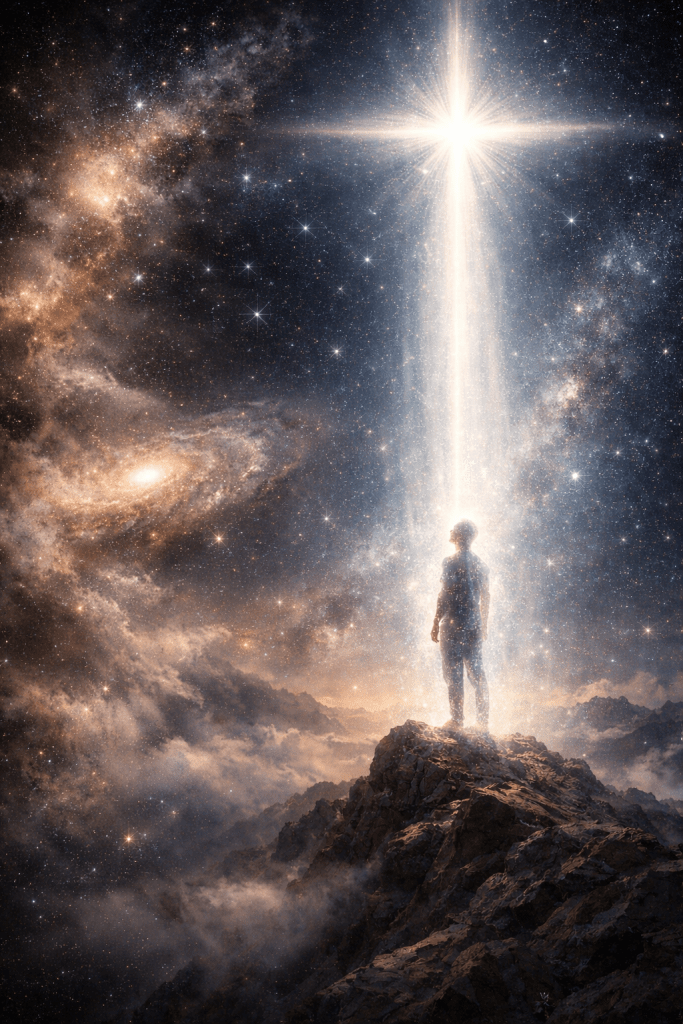
Jesus declared: “I am the Light, the Way, and the Truth. No one comes to the Father except through me.”
Light, when traveling at its maximum speed, transcends time and space as we experience them. For the photon, there is no duration and no distance; its journey is, in a certain sense, instantaneous.
Therefore, whoever enters the true Light enters eternity itself. To be in that Light is to be in the Father.
It is here that physics and theology meet.
Matter did not settle for producing a creature that merely survives. It went further — much further. It gave rise to a being capable of observing its surroundings, interpreting them, transforming them, and, above all, transcending them.
This being did not only learn to hunt, to cultivate, and to build. It learned to ask about what lies beyond, about what cannot be touched. It circled the globe, explored the oceans, climbed mountains, and now turns its gaze toward the stars. Not because it needs food or shelter in Andromeda, but because it feels a deeper necessity: to understand.
And here something even stranger appears. This same being that deciphers the universe senses, at the same time, that it does not end within it. It carries the certainty —or at least the persistent longing— that a part of it is not meant to disappear. It has called that place Heaven, eternity, or whatever name different traditions have given it.
In other words, matter has come to produce a being that not only interprets the universe, but longs to participate in something that exists beyond time and space.
At this point, the question ceases to be merely scientific and becomes existential.
After billions of years of increasing complexity, matter has not only produced life. It has produced a being capable of contemplating the universe while sensing that its origin and its destiny are not exhausted within it. A being that, while deciphering the stars, experiences a longing for eternity.
And perhaps this is the deepest reason for our existence:
not only to understand the universe, but to recognize that we do not entirely belong to it.
La materia que anhela la eternidad
Israel Centeno
Jesús declaró: “Yo soy la Luz, el Camino y la Verdad. Nadie va al Padre sino por mí”.
La luz, al viajar a su velocidad máxima, trasciende el tiempo y el espacio tal como nosotros los experimentamos. Para el fotón no hay duración ni distancia; su viaje es, en cierto sentido, instantáneo.
Por lo tanto, quien entra en la Luz verdadera entra en la eternidad misma. Estar en esa Luz es estar en el Padre.
Es aquí donde la física y la teología se besan.
La materia no se conformó con producir un animal que simplemente sobrevive. Fue más lejos. Mucho más lejos. Dio lugar a un ser capaz de mirar su entorno, interpretarlo, transformarlo y, sobre todo, trascenderlo.
Ese ser no solo aprendió a cazar, a cultivar y a construir. Aprendió a preguntarse por lo lejano, por aquello que no puede tocar. Dio la vuelta al mundo, penetró los océanos, escaló montañas y ahora dirige su mirada hacia las estrellas. No porque necesite alimento o refugio en Andrómeda, sino porque siente una necesidad más profunda: comprender.
Y ahí aparece algo aún más extraño. Ese mismo ser que descifra el universo intuye, al mismo tiempo, que no termina en él. Tiene la certeza —o al menos el anhelo persistente— de que una parte de sí no está destinada a desaparecer. A ese lugar lo ha llamado Cielo, eternidad, o como cada tradición ha sabido nombrarlo.
Es decir: la materia ha llegado a producir un ser que no solo interpreta el universo, sino que anhela participar de algo que está fuera del tiempo y del espacio.
En ese punto, la pregunta deja de ser solamente científica y se vuelve existencial.
La materia, tras miles de millones de años de complejidad creciente, no solo produjo vida. Produjo un ser capaz de contemplar el universo y, al mismo tiempo, sentir que su origen y su destino no se agotan en él. Un ser que, mientras descifra las estrellas, experimenta una nostalgia de eternidad.
Y quizá ahí se esconde la razón más profunda de nuestra existencia:
no solo entender el universo, sino reconocer que no pertenecemos del todo a él.
 Israel Centeno Author
Leave a comment