
Israel Centeno
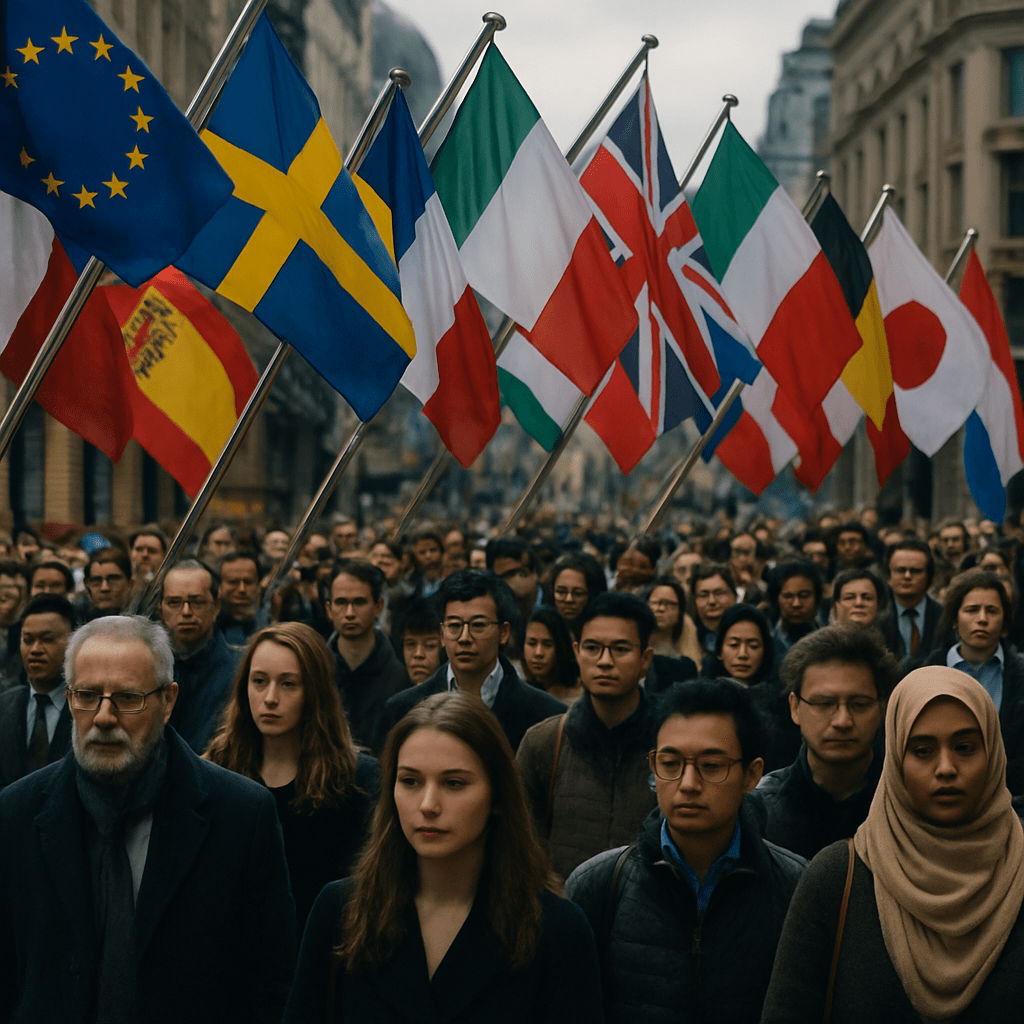
In a world increasingly defined by globalization, the concept of cosmopolitanism has once been hailed as the ideal—an interconnected world where borders blur, cultures meet, and humanity unites under shared values. This notion has been championed by intellectuals, politicians, and activists alike. But as we look to Europe and America, two major proponents of cosmopolitan ideals, it becomes clear that the dream of a cosmopolitan world is not only elusive but perhaps ultimately unattainable in the way we once imagined it.
Europe, historically the cradle of modern civilization and global progress, finds itself grappling with the very ideals it once helped to shape. The continent, once home to a vast colonial empire that stretched across the globe, was also the birthplace of intellectual movements that championed universalism and cosmopolitanism—thinkers like Immanuel Kant, who envisioned a world united by shared moral laws, or the European Enlightenment’s embrace of rationalism and shared human values.
There was a time when the idea of cosmopolitanism shone like a beacon—an aspirational ideal rooted in the dream of shared humanity, borderless understanding, and cultural sophistication. For Americans, this concept has often been romanticized through literature, film, and the myth of the great melting pot. For Europeans, however, cosmopolitanism was not merely an ideal but a lived reality, forged through centuries of cross-cultural exchange, colonial entanglements, and Enlightenment thought. Yet, somewhere along the way, this ideal has faltered.
In contemporary Europe, particularly in cities like London and Paris, one senses a deep craving for identity—an existential yearning not rooted in nostalgia, but in confusion. These capitals, once symbols of cultural grandeur and modern unity, now feel uncertain of themselves. Not because they lack diversity, but because the coherence of their identity has been frayed. What was once the proud cosmopolitanism of Paris now feels like a fragmented landscape of communities living in parallel, rarely intersecting in meaningful ways. London, too, speaks in many tongues but rarely in one voice.
This is not to say these cities are failures. On the contrary, their energy and complexity remain vibrant. But one cannot ignore the psychological fatigue that has set in—a fatigue born not of difference, but of dissonance. Cosmopolitanism, in its most generous form, requires shared frameworks: a commitment to dialogue, mutual respect, and some sense of common purpose. What we’re seeing instead is not a symphony, but a cacophony.
It would be naïve to place the blame solely on migration or globalization. These are accelerants, not causes. The deeper issue is the absence of a compelling narrative that can reconcile modern pluralism with rooted identity. In Europe, where memory and place are so intimately tied, the erosion of a common cultural narrative has left many disoriented. In recent decades, Europe has found itself increasingly divided. The promise of cosmopolitanism, once synonymous with its great cities, has been overshadowed by the resurgence of nationalism, populism, and a deep-seated anxiety about immigration and cultural integration. Cities like London, Paris, and Berlin, once seen as models of multiculturalism, have become symbols of a more painful reality: the failure of cosmopolitanism to truly unite diverse groups in meaningful ways. Europe’s post-colonial legacy is now intertwined with a new crisis of identity, where the lines between “native” and “other” have become sharper, not softer.
Meanwhile, in rural America, the resistance to cosmopolitanism stems from a different wound—one tied to the fear of erasure, of being overwritten by a culture they neither recognize nor understand.
That said, the urban-rural divide is less about geography and more about exposure. In cities, survival requires constant adaptation. In the countryside, it demands stability. This doesn’t make one superior to the other, but it does explain why the same news headline can provoke such divergent reactions.
What further complicates matters is the way modern progressivism has wrapped itself around the cosmopolitan ideal, only to distort it. In attempting to embrace everything—gender plurality, new pronouns, fluid identities, and a boundless inclusivity—it has often ended up speaking a language few understand. Instead of offering clarity and unity, it has produced a sense of ideological vertigo. As if the very idea of cosmopolitanism had been over-seasoned, served with too many conflicting flavors on the same plate.
Current progressivism blends the contradictions of the cosmopolitan ideal with alien and often incomprehensible elements. Concepts like multiple genders, the proliferation of pronouns, and a kind of ideological menu overloaded with ingredients have produced fatigue. It’s as if the progressive discourse has lost its universalist core in trying to include everything—and in doing so, has become unreadable. For many, it’s simply too much: too fast, too confusing. And that overload has ended up alienating even those who once sympathized with the cause.
Yes, the rural world resists — sometimes in reactionary ways, sometimes with wisdom. But the urban world, once the engine of progress and imagination, increasingly offers only exhaustion. It’s not a question of choosing the city over the country. It’s that both seem to be struggling with the same fundamental anxiety: how to belong in a world that no longer believes in belonging.
Cosmopolitanism, then, stands at a crossroads. What was once a beacon of modern enlightenment now feels like a broken compass. And yet, there is still hope. Because at its heart, cosmopolitanism is not about cities or ideologies—it’s about people. It’s about the human capacity to listen, to adapt, and to find meaning beyond tribe. But for that to happen, we must slow down. We must clarify. We must rebuild not just the bridges between cultures, but the foundations beneath them.
Until then, the cities will keep spinning, the towns will keep retreating, and the ideal of cosmopolitanism will remain suspended between what it once promised—and what it has become.
 Israel Centeno Author
Leave a comment