
Israel Centeno
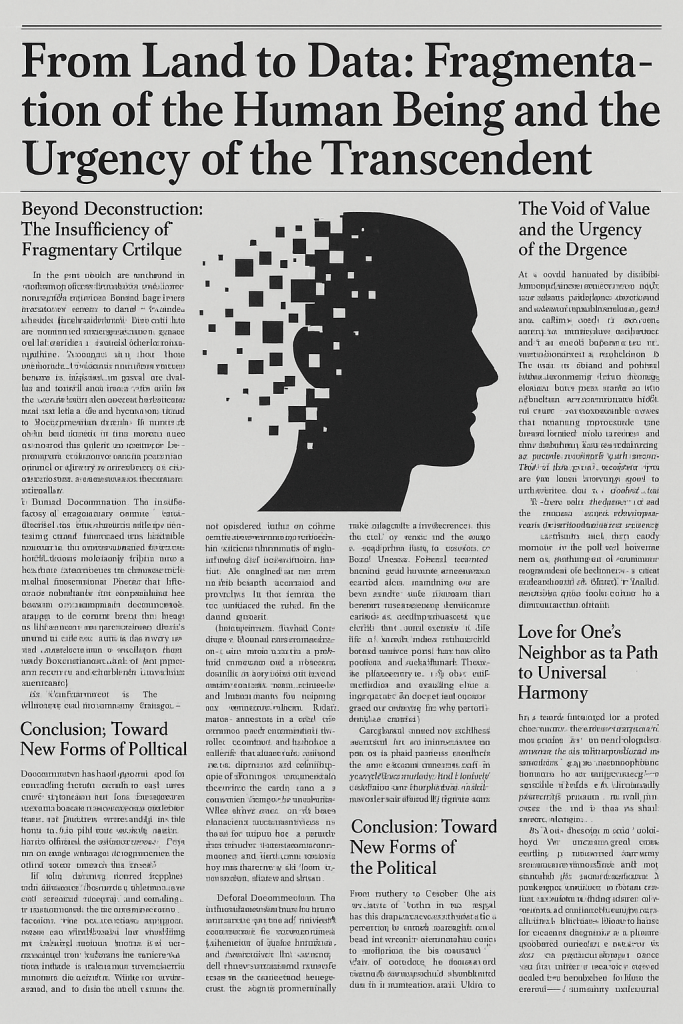
Deconstruction has been a pivotal tool for unraveling binary structures and hegemonic narratives that have dominated Western thought since modernity. But as we enter a new era, where power no longer resides solely in the hands of the state or traditional capital but is diffused through virtual infrastructures, decentralized algorithms, and shifting crypto values, deconstruction alone is no longer enough.
While deconstruction encouraged skepticism about fixed structures and categories, its success has led to an unexpected consequence: the unchecked proliferation of rights, identities, and subjectivities. Rather than liberating individuals, this multiplication has fractured the political subject, leaving us with an increasingly fragmented society. Critique, in its current form, has become a mirror image of a new world order: one ruled by informational and financial capitalism, where each person is reduced to a personal brand, an interchangeable token, or negotiable data in the marketplace of attention.
This endless multiplication of differences—political, cultural, sexual, linguistic—no longer represents ontological liberation, but rather the reconfiguration of power in the hands of algorithmic governance. The deconstructed subject has become the perfect consumer: segmented, targeted, and predictable. In this system, the right to difference becomes a commodity, and identity itself is speculative. Thus, the very tools of critique—deconstruction included—have been co-opted by the digital, market-driven forces they sought to dismantle.
In this context, the shift from traditional monetary systems to virtual value signals a profound epistemic change. Unlike the previous transition from feudalism to capitalism, where power was measured in terms of land or labor, today’s economy is driven by decentralized economies built on blockchain technology and the fluctuating values of collective perception and digital faith. Value no longer comes from physical labor, but from abstract, digital trust. In order to confront this reality, critique must move beyond textual deconstruction—it must reclaim the idea of the common good, reimagine symbolic community, and confront the challenge of a subjectivity that is not merely a consumer or a data node.
Conclusion: Toward New Forms of the Political
The historical shift from feudalism to capitalism represents not just an economic transformation, but a shift in the very way we understand power. At the same time, a humanist and liberal narrative emerged, promising freedom and progress. But as we move forward, we must reconsider the tools of critique we use to understand this new virtual economy and its systems of governance.
As deconstruction was absorbed by informational capitalism, it has lost its emancipatory potential. Today, the modern subject—shaped by the social contract—finds itself disintegrating in the face of an economy that no longer demands political participation, but only digital behavior. Traditional forms of sovereignty, grounded in nation-states, are eroding, and alternative models of power—delocalized, automated, fragmented—are reshaping the relationship between knowledge, selfhood, and society.
Our focus must shift toward reconstructing the political discourse, reimagining its symbolic systems, and rebuilding a collective vision. The history of modernity does not end in a final conclusion, but in a bifurcation: a crossroads that demands we choose between continuing the endless deconstruction of the ruins, or beginning to build something new from their remains.
From Territory to Cipher: The Abstraction of Wealth in the Virtual Era
In the feudal era, wealth was measured by land ownership. In the industrial age, it was determined by control over the means of production. Today, we face a radical shift: wealth has become increasingly immaterial, abstract, and virtual. What is at stake now is not land, factories, or even centralized banks, but the management of symbolic and digital flows—algorithms, cryptocurrencies, data markets—that assign value through invisible networks. Wealth no longer rests on the physical; it is grounded in collective belief.
Cryptocurrencies, NFTs, and derivative financial capital are symptoms of this new fetishism, where wealth is detached from all material references. This abstraction transforms not only the economy but also the very concept of the human being. The contemporary human is no longer a worker or a citizen, but an investor of the self—tokenizable, speculative, and constantly negotiating their worth in the marketplace.
The rise of virtual neo-tribalism marks a shift from universal human rights to fragmented tribal rights. The same person who fled the rigid tribalism of rural life now finds themselves caught in a new form of tribalism, one rooted in gender, identity, and algorithmic belonging. Social networks function as global villages, rewarding purity and punishing ambiguity. The subject is no longer universal; they are a data profile, segmented, identified, and commodified.
In this world of fragmented identities, deconstruction has lost its potency. It has become an endless game of shifting meanings, where everything can mean anything, but nothing carries weight. Identity has become a commodity, and difference a marketable asset. This is the paradox of our age: in the name of freedom, the subject is fragmented and dispersed, leaving behind only performance, data, and the specter of selfhood.
The Void of Value and the Urgency of the Transcendent
At the core of this fragmentation lies a profound absence: the absence of the transcendent. Wealth is no longer rooted in land or labor, but in digital abstractions—algorithms and collective perception. And what backs this new value system? Nothing but speculative faith. In a world where everything is negotiable, where identity is a commodity, and where the truth has been replaced by visibility, there is a void—a void that cannot be filled by algorithms or labels.
The human soul cannot survive in this void indefinitely. When we lose our grounding in shared truth, we descend into collective hysteria, identity cults, and the desperate need for validation. What has collapsed is not just an economic system or a political order, but meaning itself.
In this context, it is urgent—and profoundly subversive—to speak of the transcendent once more. Not as a dogma, but as a necessary structural foundation for human existence. To return to the notion of God, not as a force that controls us, but as the center of our souls, the point that grounds us in truth and love. In a world where everything is relative, the transcendent remains the only constant, the only source of order amid the chaos.
To return to God is not to regress into superstition, but to reorient ourselves toward a foundation that does not depend on fleeting digital trends or collective emotions. It is to recognize that there is a purpose beyond the self—a purpose that transcends the virtual and the material.
Love for One’s Neighbor as the Path to Universal Harmony
In a world fractured by clashing identities, fragmented rights, and digital tribes, restoring love for one’s neighbor is not a luxury but an anthropological necessity. To love the other is to recognize them as more than a social construct or political tool, but as a living image of the divine. This love transcends all divisions—race, gender, nationality, or creed.
When we love the other in this way, we no longer see them as a threat, a competitor, or a category. We see them as a brother or sister. This love is not blind or naïve. It acknowledges the reality of evil, injustice, and difference, but it confronts them from a higher principle: the dignity of the human soul, which is sacred and shared by all.
This love does not need ideological systems or political slogans. It is lived in the small, daily acts of kindness: caring for a child, showing hospitality to a stranger, working honestly, renouncing greed. It reveals itself in simple choices that sustain social harmony and personal peace.
The path to universal harmony is not uniformity
 Israel Centeno Author
Leave a comment