
Israel Centeno
“There is no aspect of the human reality that Christ did not assume—except sin. Thus, Christian hope is the certainty that God’s love is stronger than any evil, and that Christ’s victory is definitive, though not yet fully manifest.”
(cf. Catechism, nn. 602–605, 1040–1041).
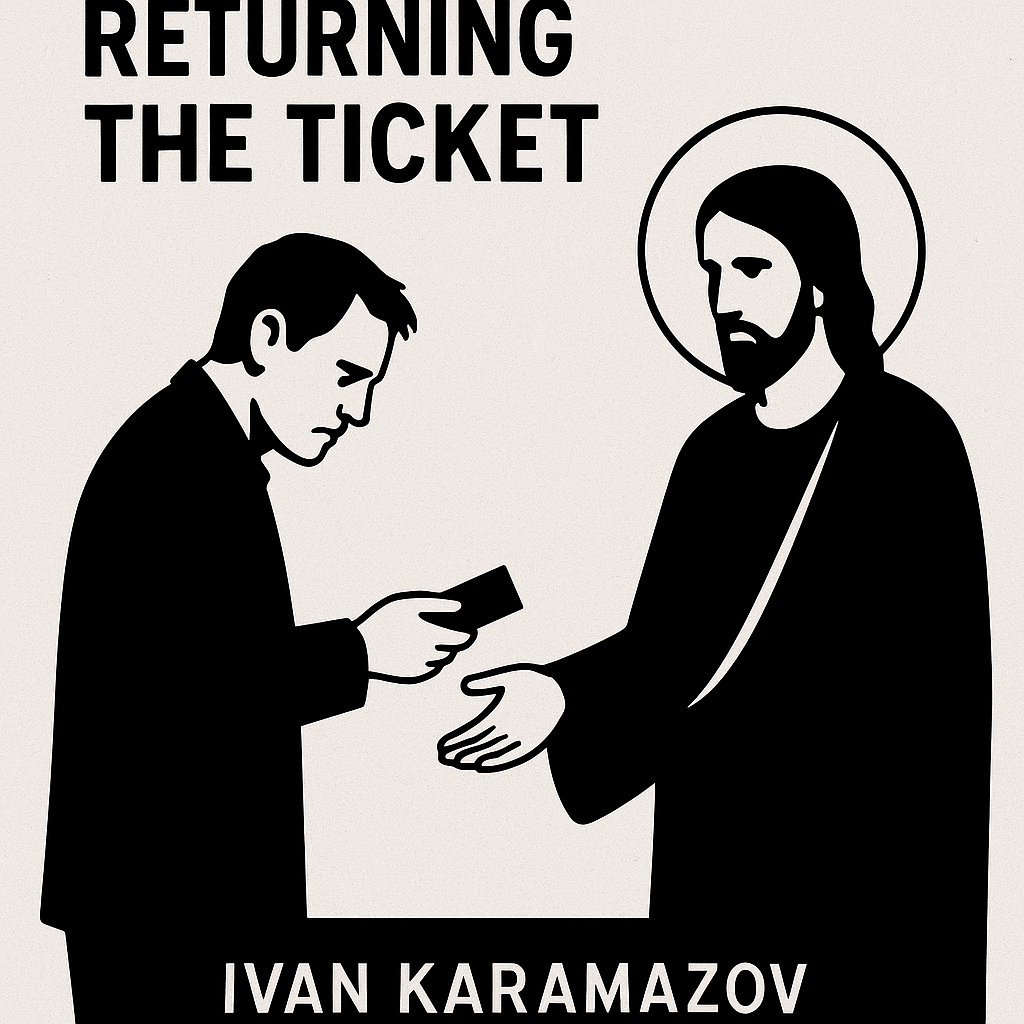
Ivan Karamazov doesn’t deny God: he returns the ticket. He does not rebel against the existence of the Almighty, but against the price of admission to a world where a child is tortured and murdered. If universal redemption demands that price, he refuses it. The gesture is literary, yes, but it holds one of the most radical objections ever raised against Christian theology: the idea of a greater good that justifies all suffering.
Ontologically speaking, evil has no being in the strict sense—it is a privation, a parasitic absence of what should be there. But even if it is metaphysically secondary, its experience is devastatingly primary. Evil wounds, fractures, humiliates. That it lacks substance does not make it any less real. The true question, then, is not only what evil is, but why it hurts so much. And even more: can evil, in all its gratuitous horror, be given a place in a redeemed world?
Thomas Aquinas says yes. God permits evil—not because He desires it, but because in His wisdom He can draw a greater good from it. For Aquinas, what matters most is not the absence of pain, but the presence of love. Willed isolation—that deliberate refusal to open oneself to another—is, for him, the worst of all fates. And suffering, if it leads to union in love, may become medicine. Christ’s Cross was not the negation of evil, but its burden carried to the extreme, so that suffering would no longer be absurd or solitary.
But Ivan is not asking from metaphysics. He is asking from horror. Can a world where innocence has been shattered—a girl frozen to death in a cellar, a boy torn to pieces by dogs before his mother—truly be saved? Does eternal joy make sense if it is built upon the blood of innocents? Is heaven still just if, among the saints, sits also the murderer—redeemed by mercy at the eleventh hour?
These are not abstract objections. They strike at the heart of faith. If everything is forgiven, what becomes of justice? If God’s love can save even the vilest, is that not a betrayal of the victim?
Theology, in the face of such questions, can only respond with fear and trembling. There is no rational answer that can console a mother who lost her child to cruelty. But there is a promise: that in the Trinitarian heart of God, every tear will be gathered, every wound restored, and every story transfigured—not by denying the horror, but by embracing it with a compassion deeper than logic. Christian redemption is not amnesia. It is transfiguration. It does not erase evil, but robs it of its final word.
Yet this promise carries a risk: the scandal of mercy. Because if God can redeem even those who have embodied evil—Hitler, Stalin, or the nameless killer—then heaven will not be a club of the righteous but a choir of the rescued. Divine justice is not distributive; it is reconciling. It does not balance scales; it restores communion.
For this reason, Ivan’s “no,” though wrenching, is necessary. It reminds us of the price that evil exacts from the innocent. But it cannot be the last word. For if redemption is real, it must not only heal the soul of the sinner—it must also restore the victim’s trust in a love that never abandoned her.
Returning the ticket is a gesture of immense moral dignity. Accepting the mystery of redemption is an act of faith—not because it denies suffering, but because it believes that beyond death, even horror can be touched, wept over, and finally redeemed by a God who did not come to explain suffering, but to suffer it with us.
 Israel Centeno Author
Leave a comment