
Being in Motion

Time, Memory, and the Paradox of Theseus’ Ship

Israel Centeno
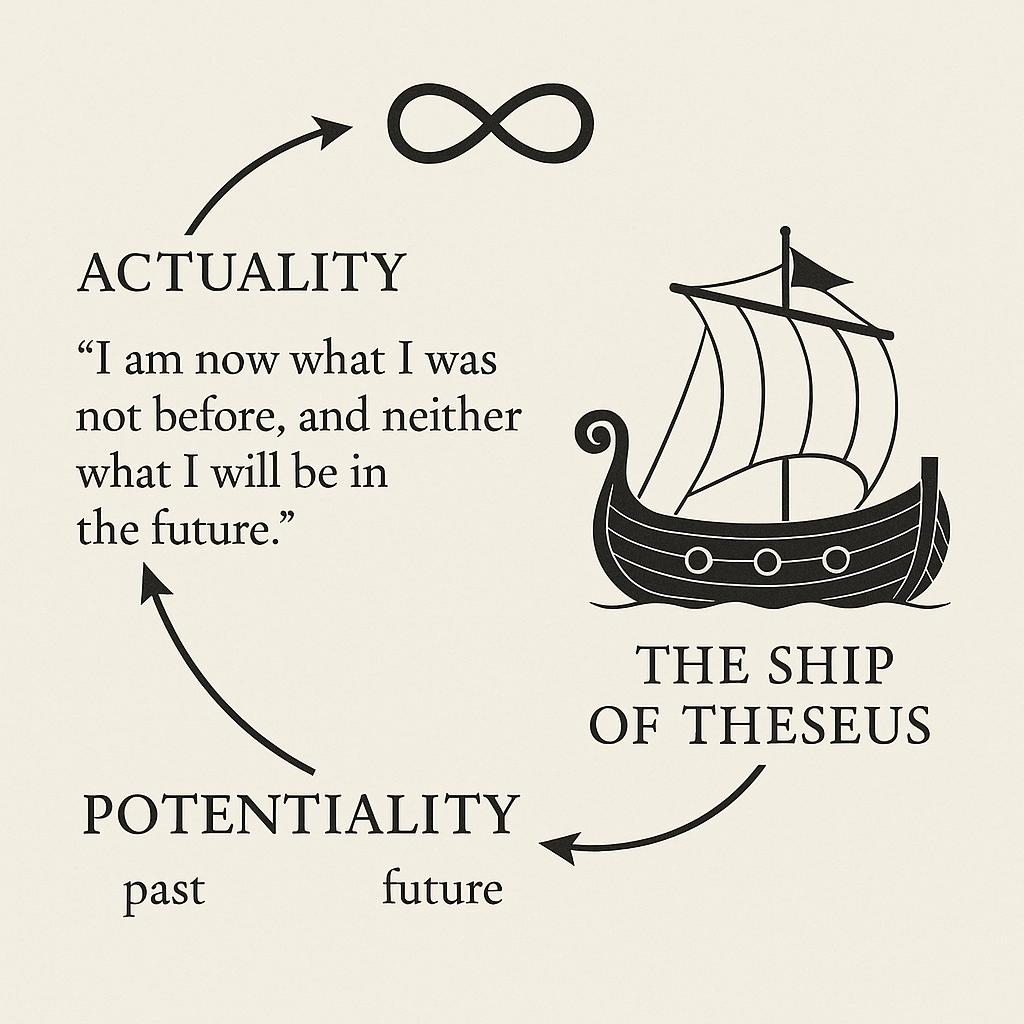
“I am now what I was not before, and neither what I will be in the future.”

Who am I, if everything in me changes? What remains, if the experience of the present transforms me, memory reconfigures me, and death strips me of the body? These questions confront us with the most intimate mystery of existence: the permanence of being amid becoming.

I. Theseus’ Ship and Identity in Change

The classic paradox of Theseus’ ship asks whether an object that has had all its components replaced remains the same object. Applied to the human being, the question becomes even deeper: if my cells change, if my memories shift, if my emotions and desires transform, am I still the same?

This paradox does not merely present a logical puzzle—it reveals a foundational intuition: identity is not an immobile substance but a structured continuity, a form that persists while its matter flows. In Aristotelian terms, being manifests as act and potency: I am actual in my present, but I contain the potency of what I was and of what I will be.

II. Time as the Horizon of Finite Being

Time is not a neutral container in which change happens. For the conscious being, time is a lived dimension. Augustine of Hippo put it clearly: the past is memory, the future is expectation, the present is attention. Time, then, is not merely what passes but what the soul preserves.

Without memory there is no time, only disconnected instants. The finite being constructs its identity by narrating itself, by engraving within a flow that becomes history. This is why death doesn’t only raise the question of the body, but of that interior imprint: where does my identity go? Is it dissolved or preserved?

III. Memory as the Inscription of Being

Memory is not only recollection but configuration of the self. Through it, the finite being reorders its experiences and recognizes itself. We are memory constantly updating, reworking the past and projecting the future. The being records, and in that recording, it sustains itself.

And even if the body dies, might not that memory—that recorded mode of being—be susceptible to another form of existence? Here opens the possibility of a transcendence that does not negate time but elevates it: an eternalized memory, not as repetition but as fulfillment.

IV. Actuality, Potentiality, and Life After Death

From Thomistic metaphysics, every being actualizes what was once in potency. Human life is constant actualization: we are born with potentialities that, as they develop, configure us as subjects. But if there is in us a spiritual principle—not reducible to matter—then that actualization can continue beyond death.

Christianity proposes that identity is not lost but transfigured in the resurrection, not as exact material restoration but as the permanence of the self in its totality. The glorified body is the final form of that personal continuity.

V. Conclusion: Between the Passing Now and the Enduring Self

The human being lives a paradox: always changing, yet recognizing itself as the same. It is act, but also potency. It lives in time, but desires eternity. Its “I” is made of present, but woven from past and projected toward the future.

Just as Theseus’ ship remains the same while it changes, I am “I” as I transform, because something—a form, a memory, a vocation for meaning—remains.

And if that “something” has a divine origin, then its destiny cannot be annihilation, but fullness.


Discover more from Israel Centeno Author

Subscribe to get the latest posts sent to your email.

6 responses to “Being in Motion”

  1. I feel like you might be interested in Rorty . And I think Theaseus ship will become a silly kids trick if mirrors. 😄

    For what you’re really saying is that when we think of the paradox of the ship, somehow it has some qualities that are mistaken, and referred to language or perception or whatever, but the language or perception does not have the same type of quality as the ship. As though I can identify something else and say that is more true, but the ship itself has these qualities because of these more true qualities.

    Seems kind of inconsistent . In what way am I able to decide that this particular quality of it over here that I’m knowing is has more truth, quality or more truth value than this other thing?

    To what are you referring in order to say that this thing holds the quality of that thing which is an illusion or whatever?

    Like

    1. I hear you—and I do think there’s a kind of liberation in treating Theseus’ ship as a linguistic puzzle rather than a metaphysical crisis. But I’m not convinced it’s just a “kids’ trick.” The fact that it persists—across centuries, across languages—suggests it touches something deeper than syntax.

      What I’m really pressing on is this: if we’re able to say “this is illusion” or “this quality is less real”, then we’re already appealing—whether tacitly or not—to some standard or intuition of truth that exceeds the categories we’re critiquing. You’re right to challenge that: “To what are we referring?”

      And maybe the honest answer is: we don’t fully know. But the very act of questioning presupposes that not all “knowing” is symmetrical. That not all descriptions are equally adequate. That there’s a directionality in our thinking—a pull toward coherence, or unity, or being—that isn’t itself reducible to language.

      So no, I don’t think I’m treating perception as false and essence as true. I’m saying that perception—and even contradiction—might be a veil, but not the last word. There’s a hunger behind the question, and I think it’s worth listening to.

      Liked by 1 person

    2. What Nyguel suggests by using Theseus’ ship isn’t that the soul is some mysterious gear that replaces parts, but that there exists in us a principle of permanence through change.
      You can call it an illusion, or say it’s just language. But the fact that we feel something of us remains—that not every change amounts to disappearance—is an experience that precedes linguistic analysis.

      And when we say “soul,” we don’t say it as a grammatical category. We say it because—even if we lose our memory, even if our body changes, our ideas, our environment—we still feel: I am still myself.

      If that’s just a hall of mirrors, then even your critique is just another reflection. But if, when you speak, you mean for your words to have any truth-value, any claim beyond the play of language—then you’re already admitting that there is something in you that isn’t just language.
      Something that knows, something that seeks truth.

      Call it soul, or not. But it’s far from trivial.

      Like

  2. I feel You might be touching on why I’m a counselor and why it is so fulfilling to me.

    Whatever is presented is presented right now. It doesn’t matter what I think about it . If there is any sort of past, then it is presented right now and there’s really no way to know if such a past ever existed except that I think it does . Even if I was to ask all the family members and friends, say, of a client, and so on, I would continually get a report from all of them of what is happening this moment. And whatever sort of communal memory that they had Would be a sort of fabric that is appearing in front of me in this particular way right now. Always. And then when I take it back and I’m working with the client. There’s the fabric. has it changed?

    You know,!Slavoj Zizek once asked a question that I think is very relevant to the boat thing. He said, can there be a change in In The manner that we understand change, and could we notice it if there is?

    And …so I have I work with people, to find out how they are thinking of the future, and how their present situation is failing (mental issues) in the context of how they understand themselves, like you have suggested.

    But there is something to say about whatever the ship is, it is the ship that we are talking about. That was my little bit about Rorty. But that only lasts as long as I’m thinking about it. Because as soon as I go to live my life, life is more than me just talking about it. There is no – I’m not really sure how i would say it – there is no continuance. ? There is no underlying theory that resides underneath everything. Whatever underlying Theory seems like it is the case. Is the case that’s arising in the condition of that particular moment.

    I really live my life that way, as though everything is presented in this moment. Intellectually, I involve myself with clients in this way (sometimes with general people) because it allows me to move through their sort of phenomenal logical problematic representation in a manner that hopefully it is helpful. And a lot of clients say it is really helpful so..and even though they don’t really know what I’m doing. Lol. So that feels good .

    But I can call whatever I’m doing, even as I do kind of stick to certain protocols that have to do with the various names of theoretical interventions (like Cognitive Therapy, say). to me, in a way, it’s just juxtaposing various configurations, what Lyotard might’ve called “phrase universes”.

    How about a client? Am I seeing the same client? Just dressed differently, with different hair, different skin tone.? am I seeing the same client over and over day after day, and I’m just thinking it’s different people?

    If I was fixing a boat, and then I went home and went to sleep and during the night someone came there and took the boat away and put a different boat there, and then I came back the next day and kept working on it, is it a different boat?

    If I painted my car, a different color, would it still be my car. Is it the same car? I say Yeah. Philosophically is it a different car? we could come up with a multitude of different ideas about the possibilities of the car. I guess I would ask is it useful for me to think that it’s a different car? Maybe in some instances it is helpful and useful for me to think it’s a different car. Say when I’m having philosophical discussions. But if I have to go to the grocery store….

    What do you think about all that?

    Like

    1. Oh correction: I DONT live my life that way…not “really” live.. auto correct.

      Like

    2. Thank you for your response. It feels more grounded in your lived experience, and I truly value that.

      You speak from the immediacy of presence—from that fabric of the “now” that unfolds in therapy, in memory, in conversation. I think I understand what you’re saying: that every past only appears as something recalled in the present, and that what really matters is the therapeutic or practical effect of the narrative, not whether there’s a metaphysical identity beneath it.

      But if I may ask, gently: what is it that experiences the change?
      What is it, in the client—or in you—that recognizes that something has changed? That one moment is not identical to the last?

      You ask: “Is it the same car?” And maybe that doesn’t matter when you’re going to the grocery store. Fair enough. But when it’s your child, your partner, your very self… it does matter. We feel rupture. We mourn loss. We remember.
      Something in us insists that not everything is just a configuration of phrase-universes.
      Something in us longs for continuity—not as comfort, but as truth.

      Žižek’s question is worth holding onto: Can there be a change in how we understand change, and could we notice it if there is?
      Yes. And maybe we notice it because there’s something in us—a spiritual thread—not static, but persistent, that constitutes who we are. A self we don’t invent, but become.

      You said your clients don’t always know what you’re doing. Maybe that’s because what you’re doing goes beyond technique: you’re witnessing a being trying to remember itself. And that’s not just helpful—it’s sacred.

      And still, if the past exists only as something that appears “now,” then…
      Did Alexander Fleming not discover penicillin? Or has penicillin always existed and Fleming never existed? Or is all of that—penicillin, Fleming, his discovery—just a present configuration of remembered phenomena?

      We can say it with humor, but the underlying point is serious: if the past has no ontological weight, then there is no history, no causality, no learning. And therefore, no responsibility.

      Because if the past isn’t real, then there is no such thing as experience.
      And if there is no experience, there can be no learning.
      And if there’s no learning, there’s no growth, no healing, no hope.

      We could repeat this ad nauseam, as individuals or as a culture, never leaving the loop of the present. But the human soul—as you surely know, since you walk with those in pain—needs something from the past to matter.
      Because only what truly happened can be forgiven.
      And only what is truly remembered can be transformed.

      Maybe that’s why, as you said, “life is more than talking about it.”
      But then, what is that more?
      What is it that keeps drawing us to narrate, to rebuild, to endure—even as we change?

      That’s where I sense something more: a form, a vocation, a permanence that doesn’t dissolve into utility. A truth we don’t invent, but that sustains us.

      Like

Leave a reply to Israel Centeno Cancel reply